|
|
| Group | Research | Teaching | Activity |
Flow of complex fluid
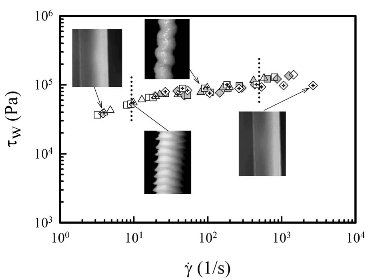
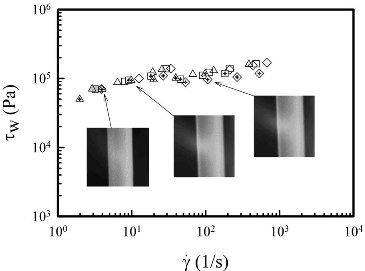
Investigations have been made on behaviors of complex fluids, such as wall slip, instability, parameter identification. The following figure shows an example.
(a) 10% |
(a) 40% |
Figure 1. prediciton of instability in capillary flows of PDMS mixed with different volume fraction of rigid particles. Diamonds:D=0.83 mm, squares:D=1.5 mm, triangles:D=2.5 mm, D being the diameter. Filled symbols: points that are predicted to be unstable. Open symbols: points that are predicted to be stable, open symbols with crosses, plus pictures, the experimental data. Dotted lines represent the lower and upper bounds of apparent shear rates over which extrudate distortions are experimentally observed. |
|
Reference
H. S. Tang, Analysis of creeping channel flows of compressible fluids subject to wall slip. Rheol. Acta, 51(2012):421–439.
H. S. Tang and D. M. Kalyon, Time-dependent tube flow of compressible suspensions subject to pressure dependent wall slip: Ramifications on development of flow instabilities, J. Rheology, 52(2008), 1069-1090.
H. S. Tang and D. M. Kalyon, Unsteady circular tube flow of compressible polymetric liquids subject to pressure-dependent wall slip, J. Rheology, 52(2008), 507-525.
D. M. Kalyon and H. S. Tang, Inverse problem solution of squeeze flow for parameters of generalized Newtonian fluid and wall slip, J. Non-Newtonian Fluid Mech., 143(2007), 133-140.
H. S. Tang and D. M. Kalyon, Estimation of the parameters of Herschel-Bulkley fluid under wall slip using a combination of capillary and squeeze flow viscometers, Rheol. Acta, 43(2004), 80-88.